
Cobot Applications
and Integration for Industrial Automation
Collaborative robotics (cobots) only realize their full potential through seamless integration into existing production environments. MKW combines automation expertise with extensive experience in the planning and implementation of cobot applications—from flexible assembly processes to integration into existing systems, control technology, and interfaces.
With the acquisition of the PTS Group’s cobot division effective January 1, 2026, MKW is expanding its automation portfolio to include collaborative robotics and supporting companies as a reliable partner on their path to smart manufacturing.
Contact Us (No Obligation)
What are cobots?
Cobots (collaborative robots) are robots that have been specifically designed to work directly alongside humans. Unlike traditional industrial robots, which often operate in designated safety zones, cobots can be used alongside employees in many applications as part of a process.
Thanks to built-in safety features, flexible programming, and a compact design, cobots integrate particularly well into existing production and assembly environments. They take on repetitive, ergonomically taxing, or precision-intensive tasks, while employees can focus on more complex activities.
The key advantage of cobots lies in their flexibility and ease of integration: They can be quickly adapted to different tasks, making them particularly well-suited for dynamic manufacturing environments with changing products, small batch sizes, or frequent process adjustments.
As an automation partner, MKW does not view cobots in isolation, but always in conjunction with the entire production structure. Integration into existing systems, control technology, and processes results in customized automation solutions that sustainably improve efficiency, quality, and ergonomics.


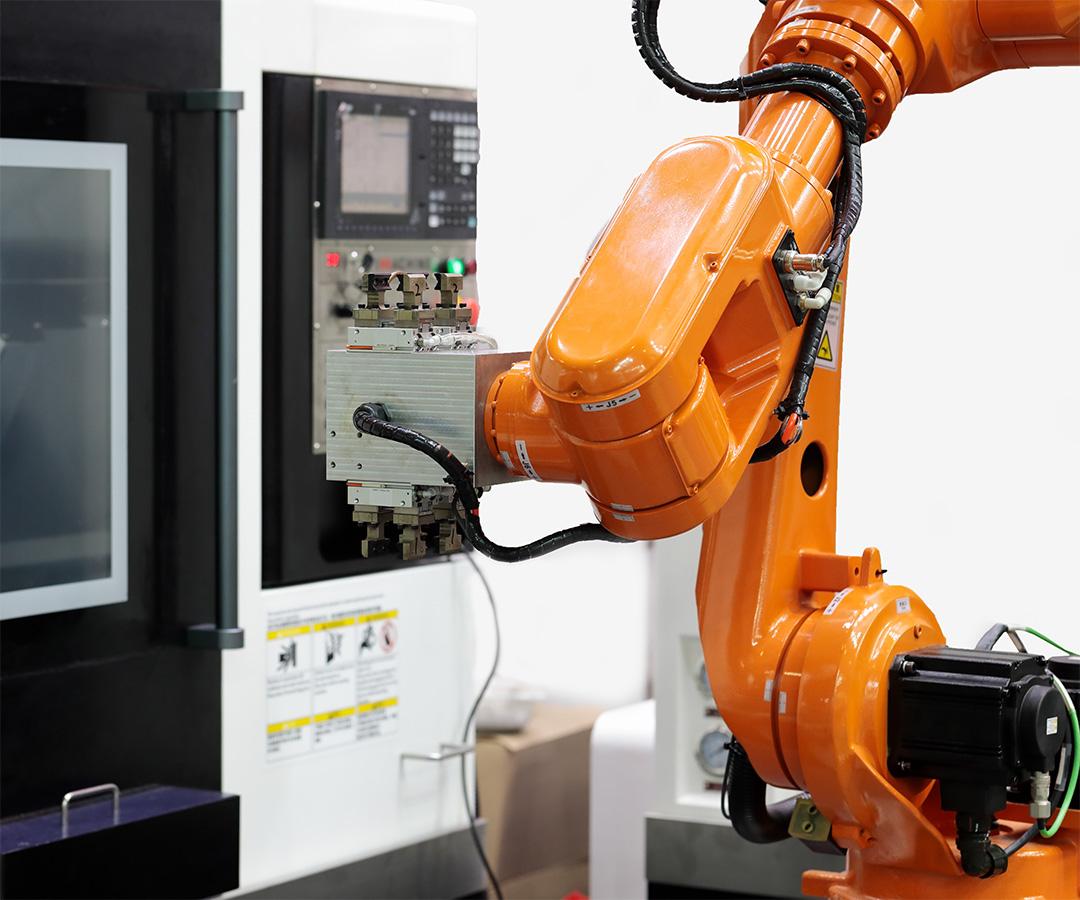
What are typical cobot applications?
Cobots can be used in the following application areas:
Machine Loading
Installation Support
Pick-and-Place
Packaging and Palletizing Smaller Loads
Component Handling in Processes with Many Variants
Ergonomic Relief for Repetitive Tasks
Robotics
Whether their use makes economic and technical sense depends largely on the process design, integration with existing control systems, and a well-thought-out safety concept.
Your Benefits
with MKW as your partner for cobot applications
Cobots have become an indispensable part of industrial automation. They offer great potential for flexible and efficient production—but their success depends on proper integration. MKW develops customized automation solutions that take your existing processes, systems, and requirements into account. From analysis and planning through to implementation, we support you as a reliable partner for collaborative robotics.
With MKW, you can rely on an automation solution that’s perfectly tailored to your production processes. We analyze your requirements and work with you to develop a cost-effective cobot application that optimizes workflows, reduces the workload on your employees, and boosts your productivity.
Your benefit: Fewer manual routine tasks, consistent process quality, and higher production capacity utilization.
Every production process is different. That’s why MKW doesn’t offer off-the-shelf solutions; instead, we take a comprehensive look at your entire application—from components and cycle times to space constraints, safety requirements, and cost-effectiveness.
Your benefit: You’ll receive a cobot solution that’s perfectly tailored to your processes and offers real long-term value.
From the initial consultation through the technical design to integration into your existing production environment, MKW provides you with comprehensive support.
Your benefit: You benefit from a structured project workflow, streamlined coordination, and professional execution—all from a single source.
The successful implementation of a cobot requires not only expertise in robotics, but also experience in mechanical engineering, automation, and process optimization. MKW combines these areas of expertise to develop robust solutions for industrial applications.
Your benefit: You reduce development risks and get your automation up and running faster.
Cobots take over repetitive, ergonomically taxing, or monotonous tasks, thereby freeing up time for more value-added work.
Your benefit: Your employees are relieved of physical strain and can focus on more challenging tasks.
Collaborative robots enable flexible automation solutions, particularly when dealing with frequently changing products or smaller batch sizes. They combine the advantages of human flexibility with the precision and endurance of modern robotics.
Your benefit: You remain flexible and can respond more quickly to changes in the market.
Not every application is automatically suitable for a cobot. MKW therefore evaluates technical feasibility and cost-effectiveness before implementing a solution.
Your benefit: You make targeted investments in automation solutions that are technically sound and economically justifiable.
A cobot should not be viewed in isolation. MKW develops solutions that can be integrated into existing processes, machines, and systems.
Your benefit: Your production remains efficient, scalable, and future-proof.
The demands placed on modern manufacturing are constantly increasing: shorter lead times, rising cost pressures, and the need for flexible production systems. With MKW as your partner, you can lay the foundation for a sustainable automation strategy.
Your benefit: You’ll prepare your production for future challenges and ensure your long-term competitiveness.
Cobot Integration into existing systems
From process analysis to the finished automation solution: A successful cobot application is the result of structured planning and a holistic approach to your production processes. MKW supports you throughout the entire project—from the initial analysis through technical implementation to optimization during ongoing operations. We combine automation expertise with a deep understanding of existing systems, processes, and individual requirements.
Our goal is to develop a solution that is technically reliable, economically viable, and integrates seamlessly into your production environment.
Working Together to Identify Potential and Understand Requirements
Every project begins with an understanding of your processes. Through a one-on-one discussion, we analyze your production workflows, identify opportunities for automation, and assess the on-site conditions. In doing so, we evaluate tasks, requirements, and existing structures to lay the groundwork for a tailor-made cobot solution.
Evaluate Technical Options and Develop Solutions
Not every process is equally suitable for automation with a cobot. That is why we assess the technical feasibility of your application and evaluate factors such as process flow, cycle times, components, environmental conditions, and required interfaces. This provides a solid basis for decision-making regarding the next steps in the project.
Plan the Optimal Solution for Your Production
Based on this analysis, we develop a customized automation concept. In doing so, we take into account not only the technical implementation but also the economic requirements of your production. Together, we evaluate the benefits, investment, and potential efficiency gains to implement a sustainable and economically viable solution.
Enabling Safe Collaboration Between People and Machines
The safety of employees and equipment is a top priority in every cobot application. MKW takes the necessary safety requirements into account as early as the design phase and develops solutions that enable reliable collaboration between humans and robots—in compliance with applicable standards and requirements.
Optimize the coordination of all components
Successful cobot integration involves more than just the robot itself. MKW develops and integrates the necessary components, such as gripping systems, fixtures, peripherals, and control technology. In doing so, we ensure optimal coordination of all systems and seamless integration into your existing production environment.
Concepts Become Productive Automation Solutions
Planning is followed by implementation: We handle the system setup, the programming of the cobot, and its integration into your processes. Through extensive testing and on-site commissioning, we ensure that the solution operates reliably and is optimally tailored to your requirements.
Ongoing support beyond the commissioning phase
Even after the successful completion of the project, MKW remains by your side. We train your employees on how to use the cobot application, optimize processes during ongoing operations, and support you with service and further development services. This ensures that your automation remains efficient and adaptable in the long term.
Feasibility Analysis of Cobots
and Assessment of Economic Viability
We assess whether a cobot application can be integrated into your current operations in a way that makes economic and technical sense based on the following criteria:
- Process Documentation
- Cycle Time Analysis
- Component Weight and Gripper Selection
- Space constraints
- Interfaces to the System
- Security Plan
- Investment and ROI Analysis
- Comparison: Cobot vs. Traditional Industrial Robot vs. Custom Solution
Safety Requirements &
Risk Assessment for Cobots
Collaborative robots are considered particularly flexible and enable direct collaboration between humans and machines. However, the fact that a cobot is used does not automatically mean that an application can be implemented without further safety considerations. The key factor is always the overall system consisting of the robot, the application, and the environment.
To ensure that a cobot can be used safely in production, the entire application must be evaluated. As part of a comprehensive risk assessment, MKW considers all relevant factors—from the robot system used, to tools and workpieces, to speed, forces, motion sequences, and direct interaction between humans and machines.
This process involves identifying potential risks early on and developing appropriate protective measures. These include, for example, selecting suitable grippers and devices, defining safe movement zones, adjusting speeds and forces, and integrating additional safety features.
Safety is not ensured by the cobot alone, but rather through the comprehensive planning and professional implementation of the entire automation solution. MKW takes occupational safety, machine safety, and relevant standards into account as early as the design phase, ensuring that your cobot application can be reliably, efficiently, and safely integrated into your production environment.
From the initial feasibility study through technical implementation to commissioning, MKW supports you with all safety-related issues and develops solutions that enable productive collaboration between humans and robots.
Where do cobots make sense?When is a cobot not the best solution?
The cost-effectiveness of using a cobot depends heavily on the specific production requirements. Not every application automatically benefits from collaborative robotics.
The following are crucial:
- Process Logic
- Cycle time
- Load Profile
- Safety Requirements
Cobots really shine in the following areas:
- Small batch sizes and processes involving a wide variety of options
- Limited space
- Direct collaboration between humans and robots
- Ergonomically Straining Tasks
- Applications involving moderate speeds
In these scenarios, they enable flexible, cost-effective automation solutions with manageable integration efforts.
Cobots are less suitable for:
- Very high cycle times
- Maximum process speed
- High load capacities
- Highly dynamic movement sequences
In such cases, MKW develops alternative automation concepts—for example, using traditional industrial robots or specialized custom solutions. The goal is always to implement your requirements in the most technically and economically optimal way.
Cobot or traditional automation?
| Criterion | Cobot (collaborative robot) | Traditional Automation / Industrial Robotics |
|---|---|---|
| Scope of Application | Flexible tasks with varying requirements, such as assembly, inspection, handling, or feeding | Recurring processes involving high volumes and clearly defined procedures |
| Flexibility | Very high: easy to reconfigure and adapt to new tasks | Medium: Changes are possible, but usually involve more effort |
| Production volume | Particularly suitable for small to medium batch sizes and frequent product changes | Ideal for high-volume production and maximum productivity |
| Speed and Cycle Time | Good for flexible processes that focus on collaboration with employees | Very high speeds and short cycle times are possible |
| Integration into Existing Systems | Often easy to retrofit and flexible to integrate | Integration is usually more extensive and more closely tied to the overall system |
| Space requirements | Compact and often suitable for use without large protection zones | Usually requires more space and separate security areas |
| Operation and Customization | Intuitive programming and quick adjustments are possible | Often higher demands on programming and technical expertise |
| Typical Applications | Assembly, Screwing, Gluing, Testing, Packaging, Material Handling | Welding, Painting, High-Speed Handling, Mass Production |
Expertise, backed by strong partners and networks


Frequently Asked Questions
About Cobot Projects
A cobot application refers to the use of a collaborative robot (cobot) that works directly alongside humans in a shared workspace. Unlike traditional industrial robots, cobots are specifically designed to handle flexible automation tasks and assist employees with repetitive or ergonomically demanding activities.
MKW develops customized cobot applications that are precisely tailored to each specific production process. In doing so, MKW considers not only the robot itself, but the complete solution, including process design, integration, and safety concepts.
A cobot is particularly worthwhile when processes need to be automated more flexibly and direct collaboration between humans and machines makes sense. Typical applications include:
- Support for Manual Tasks
- Automated Handling Processes
- Recurring Tasks to Reduce the Workload on Employees
- Processes with frequently changing product variants
- Applications with limited space
Whether a cobot solution makes economic and technical sense, however, depends on various factors—such as cycle time, payloads, safety requirements, space constraints, and process requirements. MKW therefore evaluates each application on a case-by-case basis.
Yes. MKW also integrates cobot applications into existing production environments. This process takes into account both the mechanical integration and the control system integration, as well as the relevant interfaces.
Through careful process analysis, MKW develops solutions that can be integrated into existing systems with minimal disruption. Integration during ongoing operations is also possible, provided that conditions allow it.
Employee safety is a top priority in cobot applications. Since cobots can work directly alongside people, a well-thought-out safety strategy is crucial.
During the planning phase, MKW takes the necessary safety requirements into account and evaluates the application holistically. This includes, among other things, process flows, movement zones, interfaces, and integration into the existing production environment.
The main difference lies in the nature of the collaboration and the area of application:
- Cobots are designed for flexible human-robot collaboration and are particularly well-suited for applications with varying requirements or close collaboration with employees.
- Industrial robots are often designed for very high speeds, heavy loads, or highly automated processes.
Which solution is more suitable always depends on the specific process. MKW therefore not only evaluates the use of a cobot but also develops alternative automation concepts using traditional robots or custom solutions as needed.
Implementation will take place in several steps:
- Analysis of the Existing Process and Requirements
- Assessment of Technical and Economic Feasibility
- Designing the Right Automation Solution
- Integration of the cobot into the production environment
- Implementation, including interfaces, control systems, and commissioning
MKW provides comprehensive support for projects—from the initial idea through planning to final integration into existing production structures.
Yes. Not every application is automatically suitable for a cobot. MKW analyzes the specific requirements and evaluates which solution makes the most sense from both a technical and economic standpoint.
For example, when high speeds, heavier payloads, or particularly dynamic motion sequences are required, traditional industrial robots or custom solutions may be the better choice. The goal is always to achieve an optimal automation solution—regardless of whether it is implemented using a cobot or another technology.
To conduct an initial assessment, MKW needs as much information as possible about the planned process, such as:
- Description of the current manual or automated process
- Desired Task for the Cobot
- Workpiece Data and Weights
- Required cycle times
- Existing Plant and Control Systems
- Space constraints and special safety requirements
Based on this, MKW can determine whether a cobot application can be feasibly implemented and which solution is technically viable.
Contact Us
If you have any questions or need more information, please fill out our contact form, and we will get back to you as soon as possible.

Spare Parts Inquiry for Bosch Rexroth Products
We know that the efficiency of your processes depends on the availability of critical components. A missing spare part can mean the difference between progress and downtime. With our spare parts request service, we offer you a direct channel to high-quality spare parts from Bosch Rexroth.
Whether planned or unplanned, we’ll make sure your systems experience as little downtime as possible. Just give us the necessary details, and we’ll take care of the rest.
Repair Request for Bosch Rexroth Components
Even the best systems sometimes need professional attention. If one of your Bosch Rexroth products needs repair, we make it easy for you. We forward your repair request directly to Bosch Rexroth so that your product can be restored to optimal condition by experts.
Just provide us with the product details, and we’ll ensure a quick and professional repair.